Home/Activation/Personalisation
All solutions
Personalisation
Choose a useful next action for each customer.
Recommend content, select an offer, choose when to send a message, or identify a customer who may need a follow-up. Signal uses customer activity and predictions to make these decisions available to your product and messaging systems.
Activation
Choose what happens next
A customer who just paid may need a different message from someone who stopped returning. Choose the decision you want to improve, then use each customer's history to select an appropriate next step.
- Content and profiles. Rank what the customer sees first from their activity and likely interests.
- Offers and paywalls. Choose an eligible offer or whether to show a paywall at this point in the journey.
- Message timing. Return whether a message is useful now, later, or should be skipped.
- Retention follow-ups. Prioritise customers who may leave and where keeping them is worth the effort.
Use value and churn risk to set priorities
Two customers can have the same recorded spend and need different treatment. Predicted lifetime value estimates the longer-term outcome. Churn risk estimates who may stop returning. Together with recent activity, those signals can change which action is recommended and how much effort it deserves.
Keep the signals distinct. Recorded value is what has happened. Predicted value and churn risk are estimates. They inform a decision, but they do not prove that a message or offer will change the customer's outcome.
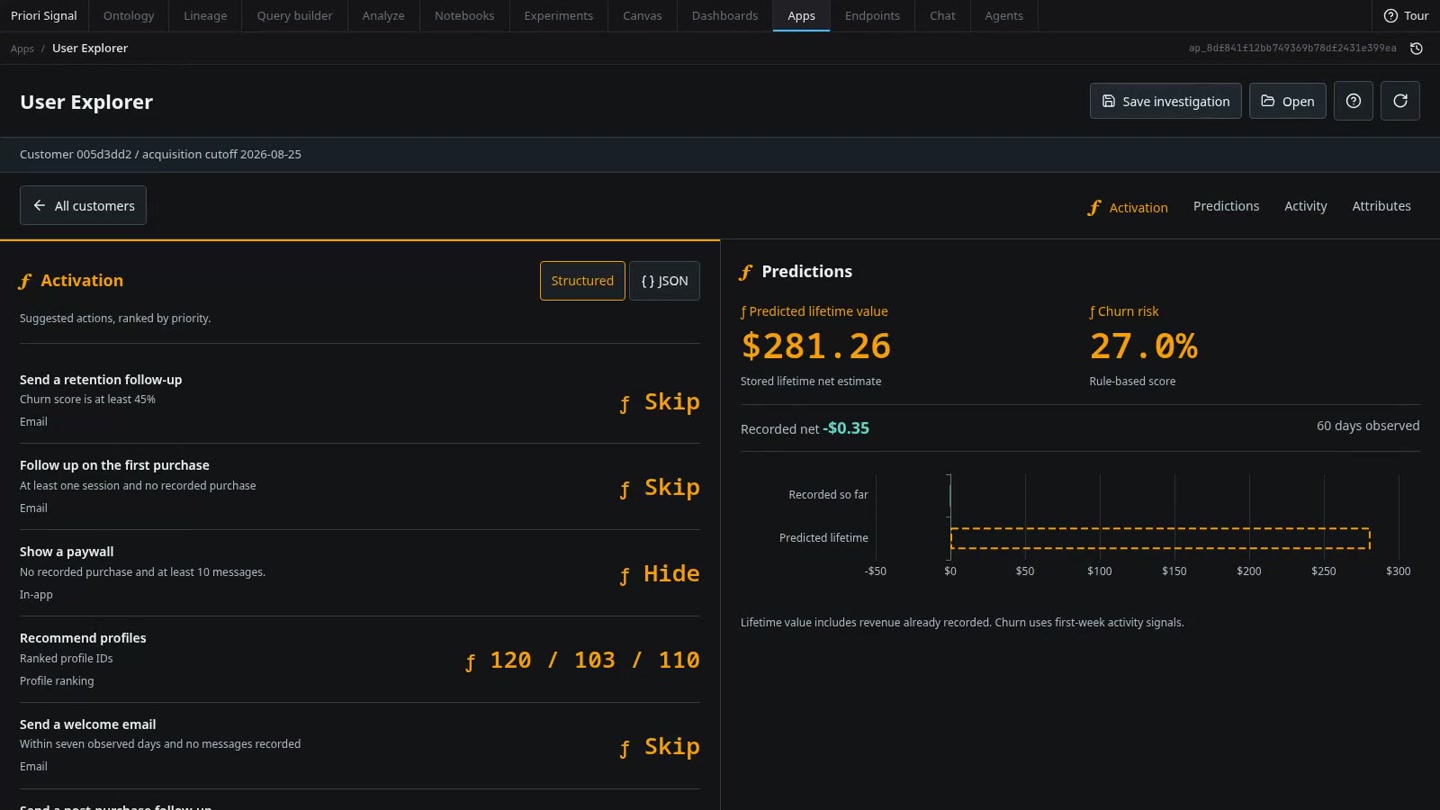
Use the decision where the action happens
A backend can request a structured response for one customer. The response can include ranked recommendations, an offer or paywall decision, a follow-up status, and the predictions behind them. Your product uses that output during a customer visit, or a customer messaging workflow uses it when selecting the next communication.
The API makes the decision available when your product or messaging system needs it. That system applies its eligibility, consent, and contact rules before showing an offer or sending a message.
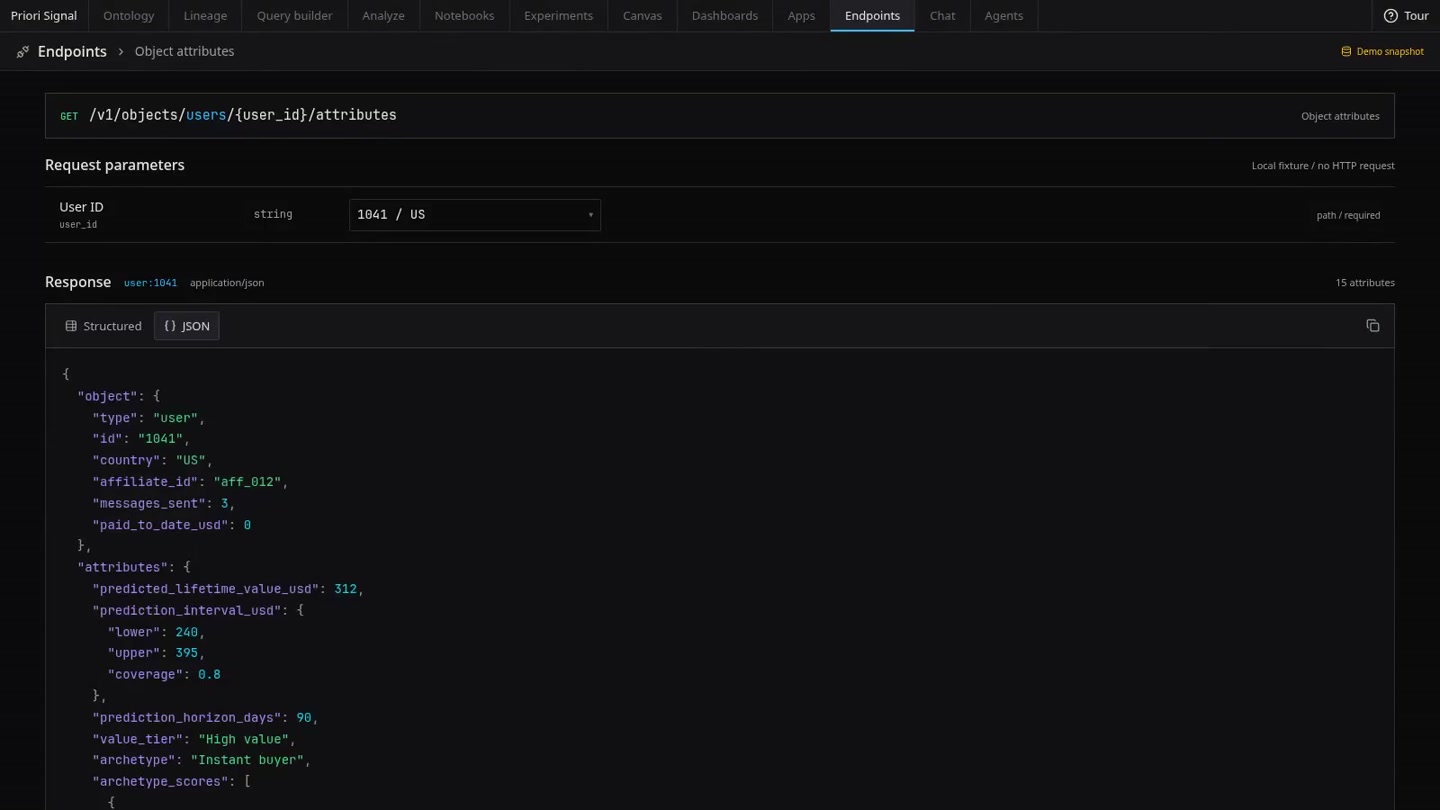
Build each decision from connected history
The shared data model connects customer activity, purchases, conversations, acquisition source, and other relevant records. Machine learning models estimate defined outcomes such as lifetime value. Rules and decision logic then combine those estimates with recent behaviour and product policy to select an action.
The customer view makes the result inspectable. A team can see the recommendation, the condition behind it, and the history used to understand the customer. The exact actions and conditions follow the decisions your business needs to make.
Measure whether the action helps
Compare value and churn estimates with later customer outcomes. Use a controlled experiment to measure whether a new message, offer, recommendation, or send time improves the result. Measure incentive and contact costs alongside the revenue gained.
See experimentation for that comparison. The same predicted customer value can also inform value-based acquisition, while the customer decision remains available to product and messaging integrations.
- Choose a specific action. Return content, offer, timing, or follow-up decisions for the customer in front of you.
- Use one structured output. Make the decision available to the product or messaging system that can act on it.
- Test the result. Measure predictions against later outcomes and product changes with controlled comparisons.